Custom Wooden Utensil Sets: Samples, Mold Fees & Timeline
Custom wooden utensil set samples: what the mold and sample fees pay for, how the money is credited back, and how long each step takes — in plain terms.
Custom Wooden Utensil Sets: From Drawing to Prototype — Mold, Sample Fee and Timeline
So you have a drawing of a utensil set you want to sell. Maybe it's a proper technical drawing. Maybe it's a photo you saved, plus a few sizes scribbled in a notebook. Either way, you send it to a factory and ask the two obvious questions: how much is a sample, and how long will it take?
Then the reply comes back with a sample fee and a mold fee, and the total makes you stop and think. Is the mold fee real, or is the factory just inventing charges because you're new?
Fair question. Let me walk you through what actually happens on our side, step by step, the way I'd explain it if you were standing in the workshop.
First, what we need from you
A drawing with sizes is best. A photo plus measurements honestly works too — plenty of our projects start that way. What we can't work from is a photo alone with no sizes at all. Wood gets cut to a length and a thickness, and a spoon made 2 cm too long isn't a sample, it's firewood.
So at the start we pin down four things: the shape and sizes, the wood you have in mind, the surface finish (oil, wax, lacquer — each looks and wears differently), and roughly how many sets you're thinking of ordering if the sample goes well. That last one matters more than people expect, and you'll see why below.
The "mold" is a knife. Literally.
This is the part nobody explains properly.
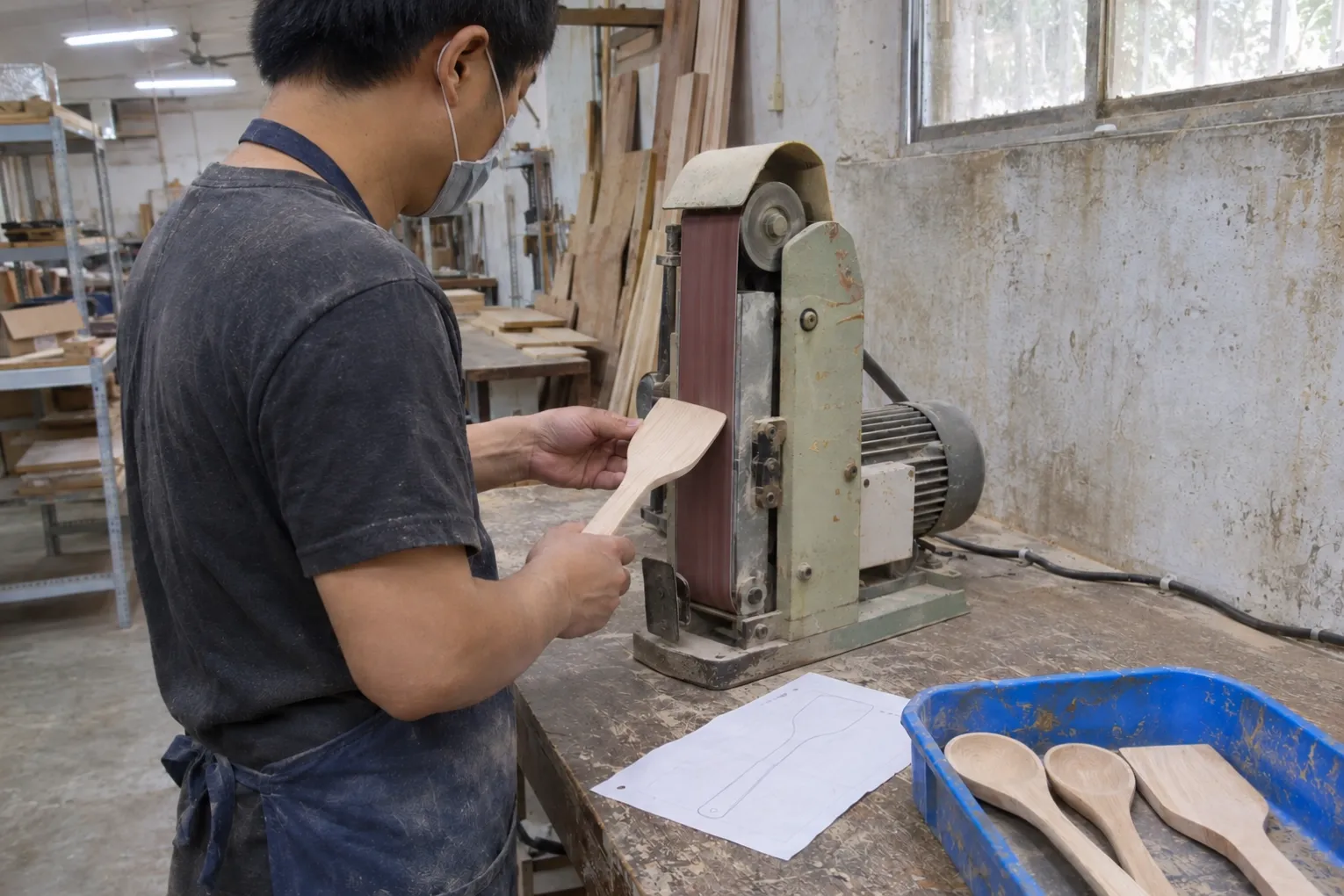
Wooden utensils aren't carved one by one with a chisel, not in production. The shape is cut and formed using steel knives, and each knife is ground to match one exact profile — the curve of your spoon bowl, the edge of your fork. A knife made for a standard spoon won't cut your wider, deeper one. It physically can't.
That knife is made for your drawing only. It can't be used for the next buyer's product, and we don't use it for anyone else's. That's the whole reason tooling shows up as a separate charge: it's a real piece of steel, made once, for one job.
The good news is it's a one-time cost. Once the knives exist, they stay here, marked for your project, and they get used for your samples, your first bulk order, and your reorders. It's also how batch two ends up matching batch one — same knives, same shape, no slow drift in the handle profile.
What the sample fee actually pays for
The sample fee is the unglamorous stuff: the wood for a handful of pieces, and a craftsman's time. Samples are slow work. On a production line, pieces move; a sample gets made, stopped, measured, sanded, checked against your drawing, and often adjusted — one set at a time. Then there's the finishing, the drying time for the finish, and packing it properly so it reaches you looking like it should.
One thing that surprises people: courier shipping is not inside the sample fee, and that's deliberate. Shipping to Texas and shipping to Toronto are different numbers, and if we hid the courier cost inside the sample fee, buyers in cheaper-to-reach places would be paying for buyers in expensive ones. We quote it separately, at what the courier actually charges, so you can see it.
There's a halfway option most people don't ask about
If your shape doesn't need brand-new knives for a first look — or you just want to check the proportions in your hand before committing tooling money — ask whether a first prototype can be made without new tooling.
It won't be a perfect copy of the final production piece, and we'll tell you honestly where it will differ. But it's usually enough to judge size, weight and feel, and to decide go or no-go before the bigger money moves. On the right project, we're happy to make that first piece first and talk about the sample fee once you've seen it and approved it. It depends on the shape, so ask.
Do you get the sample and tooling money back?
Short answer: it depends on the factory, so get it in writing before you pay, not after.
Our way of working is this: how the sample and tooling money is credited is agreed project by project, and it goes into your quotation in plain words — how much can be credited against your bulk order, and at what order quantity the fees are fully covered. A 1,000-set project and a 5,000-set project honestly can't carry the same promise, and we'd rather show you the real maths for your quantity than print a big refund promise on the website and wriggle out of it later.
And that goes for any supplier, not just us: if a factory won't put the credit terms in writing, that tells you something.
How long does it take, honestly?
There's no single number, and you should be suspicious of anyone who gives you one before seeing your shape. Here's what the time is actually made of:
- Sorting out the details — the back-and-forth on sizes, wood and finish. This partly depends on how fast we both reply.
- Making the knives, if your shape needs new ones. This is the step people forget when they count days.
- Making and finishing the samples — cutting, sanding, coating, and letting the finish dry properly. Rushing the drying is how you get a finish that fails later.
- Photos and video to you first, so you can spot anything obvious before we spend your courier money.
- The courier's days, which are the courier's, not ours.
A simple shape in a wood we have on hand moves fast. New knives and a special finish take longer. What we do — and what you should ask any factory to do — is give you an actual date once we've seen the drawing, and then be judged by that date. "About two weeks, probably" is not a date.
Once you approve the sample, bulk production for this kind of order is usually around 45 days counting from the deposit. Treat that as a reference, customised packaging and peak season can move it, so the date that counts is the one written on your proforma invoice.
The sample is in your hands. Now what?
Don't just look at it. Cook with it. Hold it wet. Run your thumb along the spoon's edge, flex the neck of the fork a little — the neck is where weak designs fail first, and better to find that out at your kitchen table than in a customer's review.
If something needs changing, it falls into one of two boxes, and the difference matters:
- We made it wrong. The size is off your drawing, the finish is rough, the shape drifted. That's a making problem. Fixing it shouldn't cost you money — you asked for one thing and got another.
- You changed your mind. You held it and now you want the handle longer or the bowl deeper. That's a design change. It may mean reworking the knives, which is new cost — but you'll see that cost and approve it before anyone cuts anything. No surprise charges, either way.
The approved sample then becomes the standard. We keep it as the reference piece — the "golden sample" — and your bulk order gets checked against it.
Quick answers
Can I skip the tooling and go straight to a bulk order?
Only if your shape matches something that already exists. If the design is truly yours, the bulk order is made with the same knives as the sample — skipping tooling doesn't save money, it just means your product won't match your drawing.
Who do the knives belong to?
They're made for your design and used only for your products. They stay at the factory so your samples, bulk orders and reorders all come off the same tooling.
Can I see a prototype before paying the full tooling cost?
Often, yes. On many shapes we can make a first piece so you can check the look and feel first. It depends on the design — send it over and we'll tell you plainly whether yours qualifies.