Ceramic vs Carbon Steel vs Stainless Mill Mechanisms
Ceramic, carbon steel or stainless — which pepper mill mechanism suits salt, pepper and your market? A plain guide for importers.
Ceramic vs Carbon Steel vs Stainless Pepper Mill Mechanisms: How to Choose
Buyers ask me which mechanism is the best one. Honestly, that's the wrong question — first ask what's going inside the mill, and where it will be sold.
These are starting points for choosing samples. They are not a quality ranking. A well-made ceramic mechanism can outperform a poorly made steel one, and the reverse is just as possible.
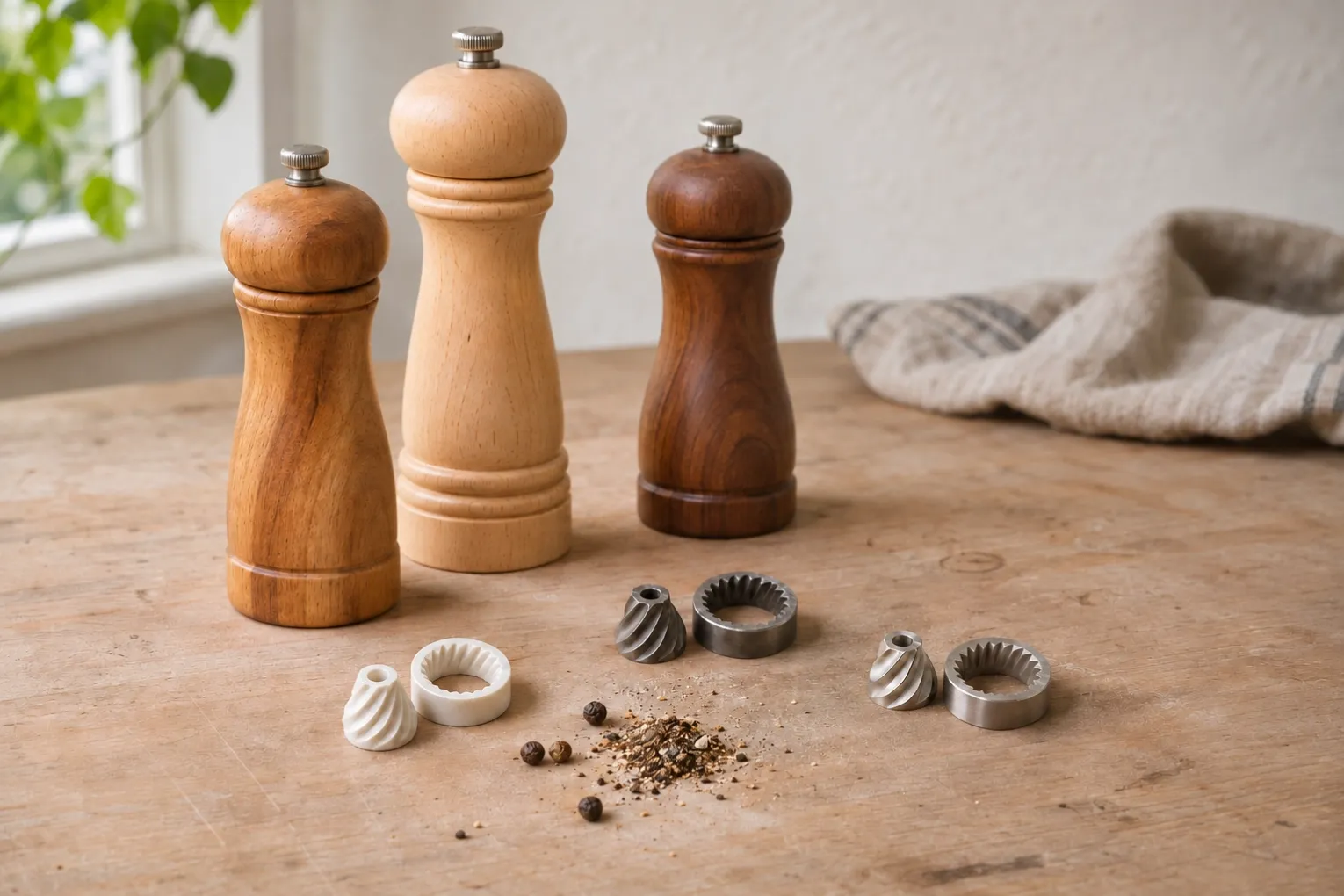
Ceramic: Useful for Salt and Pepper, With a Few Limits
Ceramic is a practical option for a matching salt and pepper set, and the usual starting point for gift sets. A mechanism designed and approved for both seasonings gives the two mills a similar construction, avoids rust on the grinding surfaces, and holds no taste — yesterday's pepper doesn't flavour today's salt.
But "ceramic" does not mean "grinds anything." Tooth shape, opening size and adjustment still have to suit the contents, and a ceramic mechanism made for dry salt is not automatically suitable for every spice. CrushGrind lists salt, pepper and dried spices for specific mechanisms only. crushgrind.com
Ceramic is hard and wear-resistant, but it can chip or crack. If a grinder jams, don't force the handle — check for trapped material or damage first. And check the parts around the ceramic — shaft, spring or screws may still be metal, so a ceramic core alone does not make the whole assembly corrosion-proof.
Carbon Steel: Worth Considering for a Dedicated Pepper Mill
Carbon steel can be hardened and formed into durable cutting teeth. A good design takes hold of the peppercorns and breaks them down without making the user work too hard — a sensible candidate for a mill aimed at people who cook often.
Its main limitation is corrosion. Plating or another protective treatment does not make it suitable for salt: Cole & Mason specifically warns against putting salt in its carbon steel pepper mechanisms because it can cause rust. coleandmasonusa.com
If you choose carbon steel for the pepper side of a matching set, specify a separate, suitable mechanism for the salt side.
For a purchase order, "carbon steel grinder" is an incomplete description. Ask the supplier to identify the mechanism model, material and protective treatment, and keep those details with the approved sample — the material name alone does not prove it grinds better than ceramic or stainless steel.
Stainless Steel: Check What the Description Actually Refers To
"Stainless steel pepper mill" can describe the outside of the product — it does not necessarily tell you what the grinding teeth are made from. First establish whether the supplier means the body, shaft, grinding parts or all three.
Stainless mechanisms are available for pepper, and their corrosion resistance is useful. But the word "stainless" says little about the shape of the teeth, how they were made or how smoothly the mill will work. coleandmasonusa.com Ask for the actual grinding-part specification and an assembled sample — if the quotation only says "steel mechanism," ask which steel, and which component.
Do not assume a stainless pepper mechanism can also grind salt. Salt compatibility needs to be confirmed for that particular design and its complete assembly.
Stainless deserves the same checks as the other options: good output, comfortable turning, an adjustment that stays put. One more point for importers: it is widely produced, so repeat orders are easier to keep consistent from batch to batch.
What Makes One Mechanism Grind Better Than Another?
The material is only part of the answer. Peppercorns must reach the teeth, the teeth must engage them, and the gap between the grinding parts must stay reasonably stable during use. A poor feed can leave the user turning an almost empty-feeling mill even when there is pepper inside; loose assembly can make the grind change unexpectedly; an adjustment with too little useful movement can leave "fine" and "coarse" looking much the same. So test mechanisms inside the finished body, not loose on a supplier's desk.
How to Compare Samples Before a Bulk Order
A useful comparison does not need expensive equipment. It does need consistent conditions.
Use the same peppercorns. Fill each sample from the same dry batch at a similar fill level.
Look at fine, medium and coarse output. Grind onto separate sheets of white paper. Are the settings visibly different? Does coarse produce useful pieces, and is fine fine enough? Aim for useful control and reasonable consistency, not identical particles.
Compare output and effort together. At a comparable grind size, collect the output from the same number of full turns — for example, 20 turns — and weigh it if you have a suitable scale. More output is not better if the grind is too coarse or the mill is tiring to turn.
Check whether the setting holds. Use the mill, put it down, then use it again, switching between settings several times. Does the adjustment move during grinding, or become difficult to repeat?
Try more than one unit. One good sample tells you that one sample works; check several units where possible. A quick sample check shortlists mechanisms — it does not establish years of service life.
How Much More Should You Pay for a Better Mechanism?
There is no dependable price order that puts the three materials into fixed budget, mid-range and premium categories. The complete component matters — design, process, adjustment parts, supplier and order quantity.
Ask for alternative mechanism quotations in the same mill body, with the same size, finish, packaging, quantity and delivery terms — that makes the price difference easier to understand, and an upgrade is easier to justify when the samples show a clear improvement the customer can feel.
Before ordering, record the approved mechanism model, intended seasoning, material details and whether substitutions require your agreement — otherwise a changed component can hide behind an unchanged quotation. And at the bottom of the market, watch for nylon or plastic gears in the cheapest mills: they wear quickly, and a suspiciously low quote often starts there.
Care Instructions Should Match the Actual Mill
Keep mills away from steam where practical — grinding over a boiling pan introduces moisture into the contents and mechanism.
For routine care, follow the instructions for the finished product. A removable ceramic part may have its own cleaning method — CrushGrind allows water cleaning of certain removable ceramic parts, thoroughly dried before reassembly — but an assembled wooden mill should not be soaked; Cole & Mason advises against submerging its mills. crushgrind.com
Do not recommend grinding salt through a carbon steel pepper mechanism as a general cleaning trick.
Clear care instructions belong on the packaging or insert, especially when the two mills in a set use different mechanisms — and marking the mills themselves, a small S and P, prevents mix-ups a leaflet alone can't.
Common Questions
Does stainless steel mean the mechanism will never rust? Avoid making that promise. Confirm the material and intended use, inspect the complete assembly and follow the manufacturer's care instructions — "stainless steel" alone does not support a lifetime rust-free claim.
Can one mechanism grind both salt and pepper? Some ceramic designs are approved for both — check the specific model. Do not extend that claim to damp salt, every spice or every mechanism in the same material.
Which mechanism should a wholesale buyer choose first? For a matching set, start by sampling a suitable ceramic option, or a pepper mechanism paired with a separate salt mechanism. For a pepper-focused product, compare well-specified ceramic and steel options in the finished body.
Planning a wooden salt and pepper mill range? Browse Napop Win's salt and pepper mills, then share your preferred size, intended seasoning, quantity and packaging requirements so available options can be checked.